Dossier III · Telomere Biology
Epitalon, telomerase, and the missing clinical record
Tracing epitalon back to its primary papers reveals an unverified mechanism, cancer-cell telomere extension in vitro, and a persistent confusion between two different substances.

Telomeres, telomerase, and why human cells keep a brake on
Every time a normal human body cell divides, it must copy its chromosomes. In 1961, Leonard Hayflick and Paul Moorhead demonstrated—as a 2022 eLife commentary by two National Institute on Aging scientists summarizes—that human fibroblast cells cultured in the laboratory can divide only a limited number of times before stopping multiplication while remaining metabolically active. In 1990, Calvin Harley, Bruce Futcher, and Carol Greider reported in Nature that the amount and length of telomeric DNA—the protective repeating sequences capping the ends of chromosomes—decrease across serial cell divisions in human fibroblasts during aging in vitro and possibly in vivo.
The molecular solution to how cells protect and rebuild those ends earned Elizabeth H. Blackburn, Carol W. Greider, and Jack W. Szostak the 2009 Nobel Prize in Physiology or Medicine: telomeres shield chromosome ends from degradation, and the enzyme telomerase rebuilds them. Yet the Nobel Assembly's own 2009 press release carried two cautions that longevity marketing rarely quotes. First, organismal aging is complex and depends on several factors, telomeres being only one. Second, when telomerase activity stays high, telomere length is maintained and cellular arrest is delayed—“the case in cancer cells, which can be considered to have eternal life.”
As telomere researcher Jerry Shay noted in a 2016 Cancer Discovery review, continuous division in advanced malignancies almost universally correlates with stabilizing telomere length by reactivating telomerase, and human cells' repression of telomerase alongside shorter telomeres may have evolved, in part, as an anticancer protection mechanism. Telomere shortening is not simply mechanical wear; it is also an evolved ceiling against runaway growth.
How a bovine pineal extract became a synthetic tetrapeptide
Epitalon entered this landscape from a decades-old branch of pineal-extract gerontology. As a 2025 review in the International Journal of Molecular Sciences recounts, the term epithalamin first appeared in accessible scientific literature in 1973 to designate a crude polypeptide extract prepared from bovine (cattle) pineal glands. Researchers subsequently synthesized epitalon (also spelled epithalon)—a synthetic tetrapeptide consisting of four amino acids, Ala-Glu-Asp-Gly (AEDG)—based on epithalamin's amino-acid composition, years before AEDG was reported in physiological pineal gland extract in 2017. Over 50 years after epithalamin first appeared in 1973, Araj et al. (2025) note plainly that the precise mechanism of action of epitalon remains unverified.
What cell and rodent studies actually found—old and new
The telomerase claim around synthetic epitalon rests largely on a 2003 cell-culture report by Vladimir Khavinson and colleagues, who found that adding epitalon to telomerase-negative human fetal fibroblasts induced expression of the enzyme's catalytic subunit, telomerase activity, and telomere elongation. Earlier animal longevity claims came from bovine extract rather than the synthetic peptide: a 1998 study by Vladimir Anisimov and Vladimir Khavinson reported that pineal extract epithalamin increased mean lifespan by 11% to 31% (P < 0.05) across female fruit flies (D. melanogaster), SHR mice, C3H/Sn mice, and LIO rats.
When Anisimov, Khavinson, and colleagues tested synthetic epitalon in female Swiss-derived SHR mice (Anisimov et al., 2003; 54 mice per group), the outcome was noticeably more modest than online summaries suggest. Epitalon did not change food consumption, body weight, mean lifespan, or total spontaneous tumor incidence. In that single-laboratory mouse experiment, treated animals showed slower age-related loss of estrous cycling, a 17.1% decrease in bone-marrow chromosome aberrations (P < 0.05), a 6.0-fold reduction in leukemia, a 13.3% increase in lifespan among the last 10% of survivors (P < 0.01), and a 12.3% increase in maximum lifespan compared with controls.
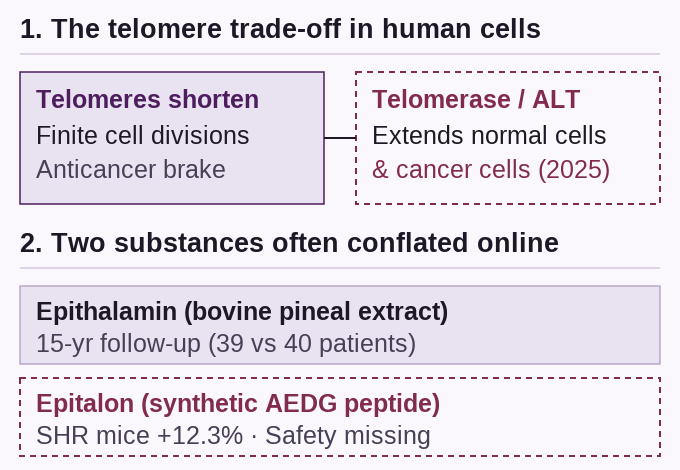
More recently, two 2025 cell studies from outside that founding group examined epitalon and telomerase. As the 2025 review by Araj and colleagues noted, a 2025 study by Ullah and colleagues showed that epitalon stimulated telomerase activity in bovine cumulus cells and cumulus–oocyte complexes. Later, on September 4, 2025, a team at Brunel University London published quantitative cell experiments in Biogerontology testing epitalon across normal human epithelial and fibroblast cells alongside two human breast cancer cell lines (21NT and BT474). That study corroborated a biological effect—and sharpened the safety question: in normal human cells, epitalon produced dose-dependent telomere length extension via hTERT and telomerase upregulation, while in the breast cancer cell lines, significant telomere length extension also occurred through ALT (Alternative Lengthening of Telomeres) activation, a telomerase-independent maintenance mechanism used by a subset of human cancers.
The compound swap hiding inside human mortality claims
Online summaries routinely claim that 12-year and 15-year clinical trials prove synthetic epitalon cuts elderly human mortality. Checking the primary abstracts uncovers a textbook compound swap. In the 12-year randomized clinical study (Korkushko et al., 2006) in elderly patients with coronary disease and accelerated cardiovascular aging, researchers reported 28% fewer deaths in the group treated with epithalamin (the pineal gland peptide preparation) than in controls receiving the same basic therapy. In the 15-year follow-up (Korkushko et al., 2011), 39 coronary patients received regular courses of epithalamin alongside basic therapy over three years while 40 control patients received basic therapy alone, again reporting significantly lower mortality in the epithalamin-treated group.
Even for bovine epithalamin, a small cohort of 39 versus 40 patients without independent, large-scale, double-blind multicenter replication would sit far short of modern clinical proof. Citing those follow-ups as human clinical trials of synthetic epitalon (AEDG) goes one step further: it attributes results from a multi-component animal gland extract to a single synthetic four-amino-acid peptide that was never tested in those cohorts.
Citing a small follow-up of a bovine pineal extract as clinical proof for a synthetic tetrapeptide mistakes two different substances for one.