Essay II · Translational Biology
Why mouse longevity so rarely survives contact with human trials
Laboratory mice are vital for cellular discovery, yet their metabolic tempo and scale bear little resemblance to a multi-decade human life. Between mouse survival curves and human medicine sits a steep translational filter.
Mice are not small humans
Longevity headlines routinely treat a rodent result as a preview of human biology, shrinking the gap between species into a footnote. In a classic 2005 analysis in EMBO Reports, evolutionary biologist Lloyd Demetrius laid out the stark physical scale dividing the two mammals: humans are roughly 3,000 times larger than mice, while a mouse's mass-specific metabolic rate—its basal energy expenditure per gram of body weight—is seven times greater than a human's.
That physiological gap reshapes how tissues age and how diseases appear. As Demetrius noted, cancer afflicts 30% of laboratory rodents by the end of their 2-to-3-year lifespan, whereas a comparable percentage is observed in humans only beyond 70 years of age. In the same 2005 analysis, Demetrius contrasted humans—an “equilibrium species” with a lower mass-specific metabolic rate, a strong capacity to maintain cellular homeostasis, and highly stress-resistant cells—with mice, an “opportunistic species” reaching sexual maturity at 35 to 50 days with weakly stable metabolic networks and rapid aging, concluding that simple extrapolation from mouse models to human aging may therefore be invalid.

When animal results collapse even inside animal labs
Before a compound ever confronts the species barrier to humans, many longevity claims stumble inside animal biology itself once experimental rigor tightens. A watershed example arrived in 2011 in Nature, when Camilla Burnett and colleagues revisited celebrated invertebrate claims that overexpressing sirtuin (Sir2) genes extended lifespan. Once they standardized genetic backgrounds and matched controls properly, the apparent lifespan extension vanished in both Caenorhabditis elegans worms and Drosophila fruit flies.
To prevent single-laboratory quirks and inbred-strain artifacts from misleading mammalian geroscience, the National Institute on Aging created the Interventions Testing Program (ITP). Evaluating up to six interventions per year, the ITP tests every candidate simultaneously across three independent sites—the Jackson Laboratory, the University of Michigan, and the University of Texas Health Science Center at San Antonio—in the genetically heterogeneous UM-HET3 mouse stock.
The ITP's track record draws a bright line between robust mammalian findings and commercial favorites:
- Reproducible late-life extension: In Harrison et al. (2009), rapamycin—an inhibitor of the mTOR growth-signaling pathway—fed beginning late in life at 600 days of age extended median and maximal lifespan in both sexes, raising age at 90% mortality by 14% for females and 9% for males.
- Five celebrated supplements that stayed null: In Strong et al. (2013), lifelong feeding started at 4 months of age with resveratrol, green tea extract, curcumin, oxaloacetic acid, or medium-chain triglyceride oil produced no statistically significant effect on male or female UM-HET3 mouse lifespan by log-rank test (a standard statistical test comparing survival curves), with only a secondary analysis hinting that green tea extract might trim midlife deaths in females.
- NAD+ precursor tested across three sites: In Harrison et al. (2021), nicotinamide riboside started at 8 months of age (at 1,000 ppm in the diet) did not significantly extend lifespan in either male or female UM-HET3 mice.
Even moving closer to humans in nonhuman primates does not eliminate study-design sensitivity. When researchers reconciled two long-running rhesus monkey caloric restriction studies in Nature Communications (Mattison et al., 2017), the University of Wisconsin study had reported a significant positive impact on survival while the National Institute on Aging study detected no significant survival effect—divergences shaped by study design, diet, and age of onset.
The clinical attrition funnel
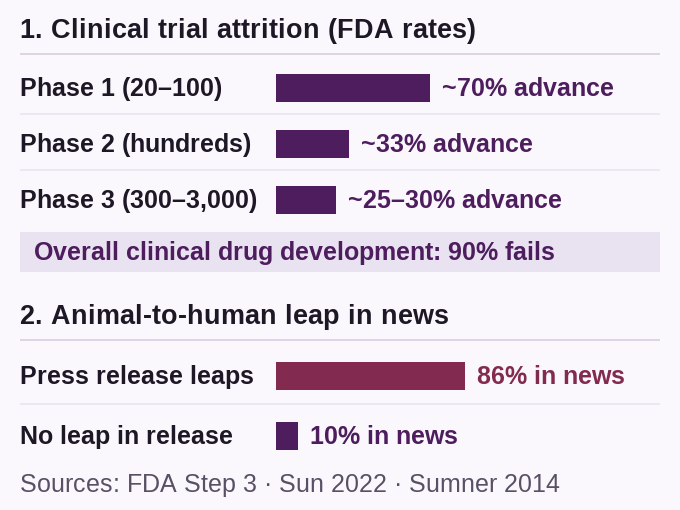
Even after a molecule clears rigorous animal models, human pharmacology remains unforgiving. Reviewing modern pharmaceutical pipelines in 2022, Duxin Sun and colleagues underscored a sobering baseline: 90% of clinical drug development fails. In cancer—a field with far clearer endpoints than aging—Mak, Evaniew, and Ghert (2014) estimated that average successful translation from animal models to clinical cancer trials sits at less than 8%, while a massive 2019 Biostatistics audit of 406,038 clinical trial entries covering over 21,143 compounds between 2000 and 2015 found an oncology clinical success rate of just 3.4%.
Regulatory progression figures explain why small early pilots never settle efficacy. As FDA's Step 3 Clinical Research page (marked current as of 01/04/2018) stood on November 18, 2026: “While preclinical research answers basic questions about a drug’s safety, it is not a substitute for studies of ways the drug will interact with the human body.” Across human phases, FDA notes that approximately 70% of drugs advance out of Phase 1 (20 to 100 participants over several months), approximately 33% advance out of Phase 2 (up to several hundred patients over several months to 2 years), and approximately 25–30% advance out of Phase 3 (300 to 3,000 volunteers over 1 to 4 years)—and adds: “Before filing a marketing application, a developer must have adequate data from two large, controlled clinical trials.”
Why human longevity trials stall on measurement
Drug development for aging faces one hurdle even steeper than oncology: deciding what counts as proof across a long human lifespan. No realistic trial can randomize young adults and wait decades to compare mortality outcomes. Researchers have therefore searched for trustworthy biological proxies.
One major technical breakthrough has been the development of epigenetic clocks—mathematical models built from DNA methylation (chemical methyl tags attached along DNA that shift predictably with time). As Steve Horvath and Kenneth Raj reviewed in Nature Reviews Genetics (2018), DNA methylation biomarkers now generate accurate chronological age estimates across human tissues throughout the life course. Yet estimating chronological age is not the same as proving that shifting a clock score extends healthy life. In 2023 in Cell, Mahdi Moqri and the Biomarkers of Aging Consortium cautioned bluntly that the current lack of standards and consensus on the properties of a reliable aging biomarker continues to hinder clinical validation—echoing Partridge, Deelen, and Slagboom's (2018) call for validated biomarkers of disease risk and response before translating animal findings to humans.
Rather than waiting for a single magic clock, clinical geroscientists have proposed staged clinical roadmaps. In 2016, Jamie Justice, James Kirkland, Nir Barzilai, and colleagues outlined proof-of-concept trials designed to test aging-targeted interventions against measurable age-related diseases and open regulatory dialogue on clinical indications. Along the same lines, Barzilai et al. (2016) proposed the TAME (Targeting Aging with Metformin) trial framework—planning to enroll 3,000 subjects aged 65–79 across roughly 14 U.S. centers to measure time to a new occurrence of a composite clinical outcome uniting cardiovascular events, cancer, dementia, and mortality alongside functional geriatric endpoints.
A real longevity trial requires thousands of older adults followed for clinical disease—not a small cohort of mice on a treadmill.
That contrast—between rigorous multi-thousand-patient trials still being built and the torrent of confident anti-aging marketing already on shelves—raises an obvious question: if the translational filter is this steep, why do longevity claims keep leaping so far ahead of it? The next essay traces the institutional, statistical, and regulatory machinery behind the hype gap.