Index · Molecules Under Review
Four molecular families, measured against human data
Longevity commentary routinely folds vitamin precursors, mitochondrial signals, synthetic tetrapeptides, and senolytic drugs onto one shelf. Chemically and clinically, they share very little.

Why unrelated molecules share one longevity vocabulary
A curious reader exploring the science of aging quickly encounters a crowded list of names—nicotinamide riboside (NR), nicotinamide mononucleotide (NMN), MOTS-c, epitalon, dasatinib, quercetin, FOXO4-DRI—spoken of in the same breath as though they were variations on a single intervention. That rhetorical grouping hides major chemical differences. NR and NMN are small molecules derived from vitamin B3 that cells convert into nicotinamide adenine dinucleotide (NAD+), a coenzyme (a helper molecule required for enzymes to work) central to cellular energy metabolism. MOTS-c is a 16-amino-acid peptide encoded inside mitochondrial DNA rather than nuclear DNA. Epitalon is a synthetic four-amino-acid peptide (Ala-Glu-Asp-Gly) modeled on an extract from bovine pineal glands. Senolytics span both small-molecule drugs such as dasatinib combined with the plant flavonoid quercetin and engineered peptides such as FOXO4-DRI designed to trigger programmed death in non-dividing senescent cells.
What binds these disparate molecules together is not a shared structure or a shared level of proof. It is their attachment to distinct mechanisms in aging biology—cellular energy balance, mitochondrial stress signaling, chromosome end maintenance, and the accumulation of senescent cells—combined with a familiar gap between what looks striking in cultured cells or laboratory mice and what has actually been established in controlled human trials.
Why peptides behave differently from small molecules
Peptides are short chains of amino acids—larger and more fragile than conventional small-molecule compounds like vitamin B3 precursors, yet smaller than full-length proteins such as antibodies. Peptide therapeutics are not fringe medicine: since the introduction of insulin almost a century ago, more than 80 peptide drugs have reached the market across conditions including diabetes, cancer, osteoporosis, multiple sclerosis, HIV infection, and chronic pain.
Turning a biologically interesting peptide into a reliable medicine, however, presents delivery obstacles that small molecules rarely face. As Daniel Drucker summarized in a 2020 review of oral peptide therapeutics, protein and peptide therapeutics require parenteral administration (delivery outside the digestive tract), which can deter medication adherence, because oral delivery faces substantial barriers related to the structural organization and physiological function of the gastrointestinal tract. Drucker highlighted the advances that led to the landmark approval of an oral formulation of the glucagon-like peptide 1 receptor agonist semaglutide (Rybelsus, related to injectable Ozempic and Wegovy) for the treatment of type 2 diabetes.
Those pharmacological realities matter when reading aging literature. A peptide that produces a clear signal in cultured cells or laboratory mice still requires dedicated clinical development in people. As a 2020 review of mitochondrial-derived peptides reported, CB4211 was the first therapeutic candidate based on a mitochondrial-derived peptide to enter clinical testing in humans—completing a Phase 1a/1b randomized, double-blind, placebo-controlled trial evaluating safety, tolerability, pharmacokinetics, and pharmacodynamics in 88 healthy non-obese participants and participants with nonalcoholic fatty liver disease (NAFLD).
Where published evidence stops across the four families
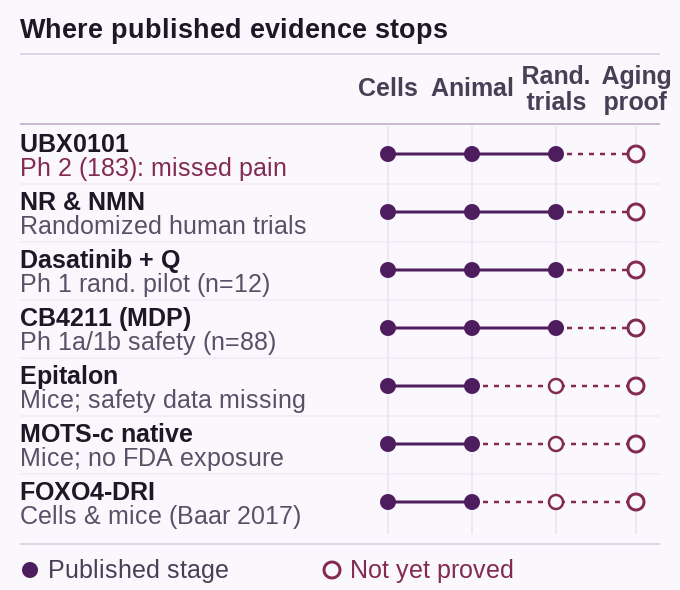
Sorting these compounds by the furthest stage of published human evidence separates familiar narratives from clinical reality. Both NAD+ precursors and senolytics have reached randomized, placebo-controlled human trials—yet neither class has proved human aging benefit. NAD+ precursors (NR and NMN) have accumulated multiple randomized, placebo-controlled human trials, though most NR trials enrolled 40 or fewer volunteers over 1 to 20 weeks and a 2024 review noted that clinical efficacy has been limited compared with preclinical animal work, while nicotinamide riboside did not extend lifespan significantly in genetically heterogeneous UM-HET3 mice of either sex.
Among senolytics, the small-molecule MDM2–p53 inhibitor UBX0101 reached a Phase 2 randomized, double-blind, placebo-controlled trial in 183 patients with moderate-to-severe painful knee osteoarthritis, where initial data did not meet the primary objective of pain modification at 12 weeks. Dasatinib plus quercetin has completed small Phase 1 pilots, including a Phase 1 single-blind randomized, placebo-controlled trial in 12 idiopathic pulmonary fibrosis patients where non-serious adverse events were higher in the treated group (65 versus 22) and exploratory functional outcomes did not appear to differ meaningfully between groups, while the peptide FOXO4-DRI was tested in cultured cells and mice in 2017. For mitochondrial peptides, CB4211 completed Phase 1a/1b safety and pharmacokinetic testing (n = 88), whereas FDA's bulk drug substances page (current as of 04/22/2026; opened November 18, 2026) reports no identified human exposure data for MOTS-c. For synthetic epitalon, a 2025 review noted that critical safety and toxicity data remain missing before approval, while the widely cited 15-year follow-up of 39 treated versus 40 control coronary patients administered bovine pineal extract epithalamin rather than synthetic epitalon.
How regulatory categories divide the same longevity conversation
A second source of public confusion is that these compounds sit in distinct statutory categories in the United States—categories whose exact limits appear in official agency postings.
Each of the four dossiers that follow examines one family in full detail—tracing its cellular biology, auditing every major preclinical and human study, and recording the safety questions that still stand between laboratory discovery and settled human care. Readers who want the broader biological framing first can begin with Aging Biology: Hallmarks and Trade-Offs, or move directly into Dossier I: NAD+ and Its Precursors.