Dossier IV · Cellular Senescence
Cellular senescence: protective brake, inflammatory burden, and an unfinished drug class
Human senolytic trials remain small and mixed, a Phase 2 trial missed its goal, and mouse work shows some senescent cells are indispensable.
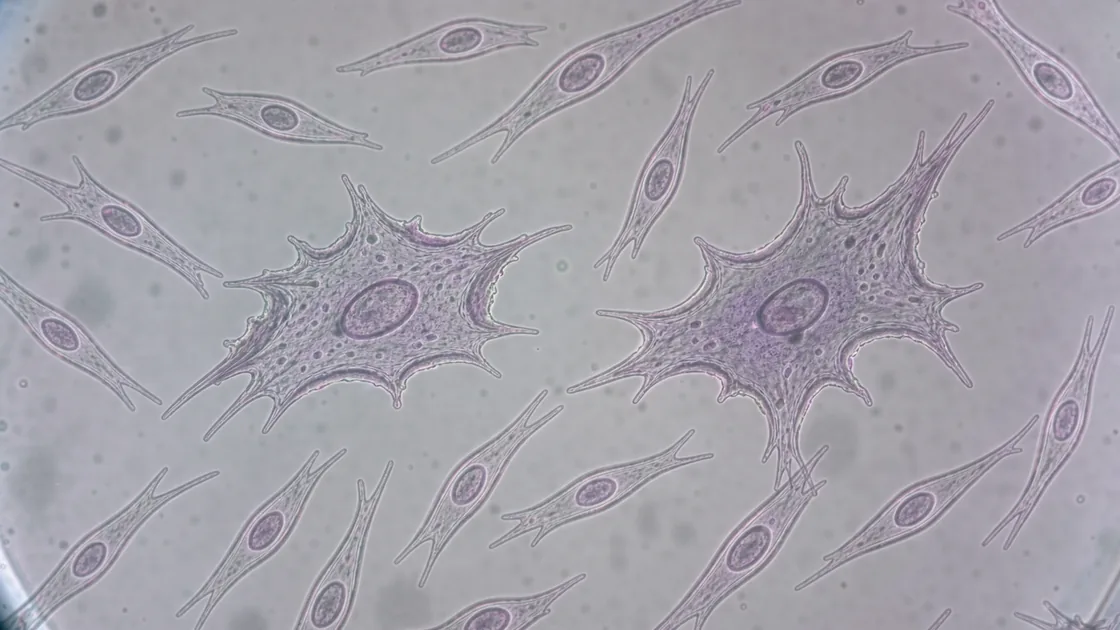
A double-edged survival program inside aging tissues
When a cell suffers severe DNA damage, telomere erosion, or cancer-promoting stress, it faces a choice between dying outright (a programmed self-destruction called apoptosis) or entering cellular senescence. As Darren Baker and colleagues summarized in Nature in 2016, cellular senescence is a stress-induced irreversible growth arrest—frequently marked by expression of the cell-cycle braking protein p16(Ink4a), encoded by the Cdkn2a locus—that blocks pre-cancerous cells from multiplying while serving constructive roles in tissue remodeling during embryonic development and wound healing.
The catch is what happens when those arrested cells linger instead of being cleared by the immune system. Senescent cells remain metabolically active and begin secreting a cocktail of inflammatory signaling proteins, cytokines, and tissue-remodeling enzymes known as the senescence-associated secretory phenotype (SASP). In her 2013 Annual Review of Physiology synthesis, Judith Campisi explained that while senescence acts as a potent tumor-suppressive mechanism, accumulating evidence indicates it also drives both degenerative and hyperplastic (overgrowth) pathologies by fueling chronic inflammation—a textbook instance of antagonistically pleiotropic biology. Nor does senescence operate in isolation from other aging pathways: 2019 cell and mouse work in Nature Cell Biology demonstrated that NAD+ metabolism governs the proinflammatory SASP itself.
How senolytics emerged in laboratory mice
Two landmark mouse papers launched the modern hunt for senolytics—agents designed to selectively kill senescent cells while sparing healthy dividing or quiescent cells. In 2015 in Aging Cell, Yi Zhu, Tamara Tchkonia, James Kirkland, and colleagues coined the term after showing that senescent cells stay alive by switching on pro-survival networks that shield them from apoptosis. Targeting those survival pathways with two existing small molecules—dasatinib (a tyrosine kinase inhibitor) and quercetin (a plant flavonoid)—selectively eliminated distinct senescent cell types in culture: dasatinib killed senescent human fat-cell progenitors, while quercetin targeted senescent human endothelial cells and mouse bone-marrow mesenchymal stem cells (BM-MSCs). In vivo, combining dasatinib and quercetin reduced senescent cell burden in chronologically aged, radiation-exposed, and accelerated-aging progeroid Ercc1(-/Δ) mice, improving cardiac and vascular reactivity 5 days after a single dose in old mice and sustaining improved exercise capacity for at least 7 months in mice after limb irradiation.
A year later, Baker et al. (2016) used a genetic suicide switch (activated by the compound AP20187) to clear naturally occurring p16(Ink4a)-positive cells in mice, extending median lifespan in both male and female animals across two distinct genetic backgrounds. Soon after, senescence researchers demonstrated that peptides could pursue the same goal: in 2017 in Cell, Marjolein Baar and colleagues designed an engineered FOXO4-DRI peptide that disrupts binding between FOXO4 and the tumor-suppressor protein p53, driving p53 out of the nucleus and triggering selective apoptosis in senescent cells. In mice, that FOXO4-DRI peptide neutralized doxorubicin-induced chemotoxicity and restored fitness, fur density, and kidney function in both fast-aging XpdTTD/TTD and naturally aged mice.
What happened when senolytics met human clinical trials
Senolytic drug candidates have also entered early human clinical trials—and the contrast between unblinded pilot studies and randomized placebo-controlled trials offers one of the clearest lessons in longevity medicine.
| Study & Agent | Design & Cohort | Biomarker / Safety Record | Clinical Outcome |
|---|---|---|---|
| Justice et al. (2019) — Dasatinib + Quercetin | Open-label two-center pilot; 14 patients with stable idiopathic pulmonary fibrosis (IPF) over 3 weeks | 100% retention (13/14 completed assessments); 1 serious adverse event reported; circulating SASP changes inconclusive | 6-minute walk distance, 4-meter gait speed, and chair-stands improved (p < 0.05) without a placebo control; pulmonary function, chemistries, frailty index (FI-LAB), and reported health unchanged |
| Hickson et al. (2019) — Dasatinib + Quercetin | Open-label Phase 1 pilot; 9 individuals with diabetic kidney disease (3-day oral course, biopsied at 11 days) | Lowered adipose tissue senescent markers, skin epidermal p16INK4A+ and p21CIP1+ cells, and circulating SASP factors (IL-1α, IL-6, MMP-9, MMP-12) within 11 days | Preliminary target-engagement biopsy report; not powered or controlled to test clinical disease benefit |
| Nambiar et al. (2023) — Dasatinib + Quercetin | Phase 1, single-blind, randomized, placebo-controlled pilot; 12 IPF patients aged >50 (1:1 over 3 weeks) | No serious adverse events related to D + Q, but far more non-serious adverse events in the active arm than placebo (65 vs. 22) | Underpowered for efficacy; exploratory frailty, pulmonary, and physical function measures did not appear to differ meaningfully between groups |
| NCT04129944 / Astrike-Davis et al. (2022) — UBX0101 | Phase 2, randomized, double-blind, placebo-controlled trial; 183 patients with moderate-to-severe painful knee osteoarthritis | Single intra-articular injection targeting the MDM2–p53 interaction | Did not meet the primary objective of pain modification at 12 weeks |
Tracing that arc from 2019 to 2023 explains why experienced trialists insist on blinding and placebo controls. In the first-in-human open-label IPF pilot (Justice et al., 2019), 14 patients knew they were receiving active therapy; effort-dependent physical tests such as walking speed and chair-stands improved, even while objective lung function and clinical laboratory panels stayed flat. In the 9-patient diabetic kidney disease pilot (Hickson et al., 2019), biopsies offered encouraging proof of concept that a brief oral course can lower adipose and skin senescence markers in humans within 11 days—yet biomarker drops are not clinical outcomes.
When IPF testing introduced randomization and a matching placebo in Nambiar et al. (2023), the active arm logged far more non-serious adverse events than placebo (65 versus 22) and exploratory physical and pulmonary measures no longer separated cleanly from placebo. And when the MDM2–p53 senolytic candidate UBX0101 reached a substantial double-blind Phase 2 trial in 183 knee osteoarthritis patients, it failed to beat placebo on 12-week pain reduction—echoing animal studies in which UBX0101 did not reduce osteoarthritis severity in 18-month-old mice.
Clearing senescent cells is not a simple spring cleaning when some arrested cells are still holding the vascular wall together.