Dossier I · Coenzyme Metabolism
NAD+ precursors raise blood levels. Proving they slow aging is harder.
Vitamin B3 precursors of NAD+ carry the deepest shelf of human clinical trials in longevity research—and show why moving a blood biomarker is not the same as slowing human aging.
What NAD+ actually does inside a cell
Nicotinamide adenine dinucleotide (NAD+) is a small-molecule coenzyme (an essential helper molecule for enzymes) found in every living cell. Its classical role lies in redox reactions—electron transfers central to energy metabolism. The human cost of depletion has been clear since 1937, when Conrad Elvehjem showed that pellagra (marked by dermatitis, diarrhea, and dementia) stems from dietary niacin (vitamin B3) deficiency and low NAD+ and NADP+ pools.
NAD+ also serves as a consumable substrate for three non-redox enzyme families: sirtuins (protein-modifying enzymes), poly(ADP-ribose) polymerases or PARPs (DNA-repair enzymes), and NAD+ glycohydrolases such as CD38. Each consumes NAD+ and yields nicotinamide (NAM), which cells recycle into fresh NAD+ via the salvage pathway.
Because NAD+ has a short cellular half-life of roughly one hour in mammalian cells and limited ability to diffuse across cell membranes, studies rarely deliver intact NAD+ directly. Instead, trials test smaller vitamin B3 intermediates—mainly nicotinamide riboside (NR) and nicotinamide mononucleotide (NMN)—that feed the salvage pathway.
The age-decline premise—and the sirtuin debate
Interest in restoring NAD+ grew from two lines of evidence. First, human tissue measurements suggest NAD+ concentrations may be roughly 10% to 80% lower with advancing age, though declines vary across tissues. Second, early aging biology linked lifespan extension in invertebrates to NAD+-dependent enzymes called sirtuins.
That second pillar proved far shakier than marketing implies. In a 2011 re-examination in Nature, Camilla Burnett and colleagues standardized genetic backgrounds and matched controls, finding that apparent lifespan gains from sirtuin overexpression vanished in both Caenorhabditis elegans worms and Drosophila fruit flies. In 2022, biochemist Charles Brenner reviewed the animal literature in Life Metabolism and urged rejecting claims that sirtuins have a conserved link to animal lifespan or act as the primary mediators of NAD+ repletion.
What randomized human clinical trials actually show
Reviewing NR trials in 2023, Kaitlin Freeberg and colleagues noted intervention durations of 1 to 20 weeks, with most trials enrolling 40 or fewer volunteers—limiting definitive conclusions about physiological function. Five closely cited randomized, placebo-controlled trials show the split between blood shifts and clinical outcomes:
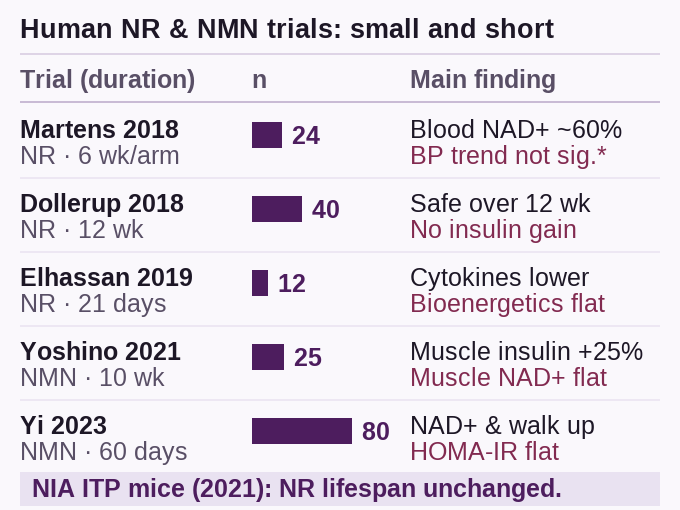
| Study & Precursor | Population & Duration | Biomarker Shift | Clinical / Physiological Result |
|---|---|---|---|
| Martens et al. (2018) — NR | 30 healthy middle-aged and older adults randomized (24 completed); 2 × 6-week crossover | Raised peripheral blood mononuclear cell NAD+ by ~60% | Blood pressure trends not significant after multiple-comparison correction; no change in energy expenditure, glucose control, or insulin sensitivity |
| Dollerup et al. (2018) — NR | 40 healthy sedentary obese men (BMI > 30 kg/m², ages 40–70); 12 weeks parallel | Tolerated safely across 12 weeks | Insulin sensitivity, endogenous glucose production, and glucose disposal and oxidation did not improve |
| Elhassan et al. (2019) — NR | 12 aged men; 21-day double-blind crossover | Augmented skeletal muscle NAD+ metabolome; lowered circulating inflammatory cytokines | Muscle RNA sequencing showed downregulation of energy-metabolism pathways without altering mitochondrial bioenergetics |
| Yoshino et al. (2021) — NMN | 25 overweight or obese postmenopausal women with prediabetes (13 NMN, 12 placebo); 10 weeks | Muscle NAD+ content unchanged, though breakdown metabolites rose (higher turnover) | Muscle insulin sensitivity rose 25±7% (p < 0.01); body composition, liver fat, blood pressure, glucose, insulin, and lipids unchanged |
| Yi et al. (2023) — NMN | 80 healthy middle-aged adults; 60-day multicenter parallel trial | Blood NAD concentrations increased at days 30 and 60 (all p ≤ 0.001) | Six-minute walking distance rose versus placebo at days 30 and 60 (all p < 0.01); HOMA-IR (insulin resistance index) unchanged at day 60 |
Read together, these trials show a clear pattern: oral precursors raise blood NAD+ metabolites, and isolated trials report localized shifts—such as higher muscle insulin sensitivity in 25 prediabetic women or longer six-minute walking distances in 80 adults—while broader metabolic and bioenergetic endpoints frequently stay flat. As a 2024 review by Tooba Iqbal and Takashi Nakagawa concluded, despite versatile effects in animal studies, clinical efficacy in humans has been limited and insufficient to ameliorate diseases, and orally administered NAD+ intermediates interact with the gut microbiome.
What happened when NR faced a rigorous lifespan test in mice
Even in mice, lifespan extension does not always survive rigorous replication. In 2021, the National Institute on Aging's Interventions Testing Program—testing compounds across three sites in the genetically heterogeneous UM-HET3 mouse stock—reported results for nicotinamide riboside fed from 8 months of age. Despite prior enthusiasm, nicotinamide riboside did not extend lifespan significantly in either male or female UM-HET3 mice.
Moving a blood coenzyme marker proves absorption and biochemical turnover—not that human aging has slowed.